
You can have the flight booked and your dog ready to go. Then the crate is checked at the counter.
The door is wrong. The fasteners are plastic. Or your dog's ears touch the roof.
Your dog can be turned away there and then. That can mean a missed flight, rebooking fees, and in some cases boarding charges while a compliant crate is sourced.
This is why "airline-approved" on a box is not enough. For excess baggage or cargo travel, airlines worldwide reference the International Air Transport Association's Live Animals Regulations (IATA LAR). The crate has to satisfy that standard in the real world, with your dog standing inside it.
I can explain the checks that matter. The final size still depends on your dog's body shape. The free travel planner will tell you exactly which IATA crate bucket applies to your dog.
UK → UAE dog relocation · Free · No signup
What airline staff are looking for
IATA-compliant means the crate follows the construction and ventilation rules in IATA LAR. It must also fit the dog correctly. Almost every commercial airline operating internationally uses these rules as its baseline for pet travel.
The shell must be rigid, in hard plastic or fibreglass. It needs a solid roof and floor. The door must be metal and secure. The fasteners must be metal too. Ventilation openings must cover at least 16% of the crate's surface, across a minimum of three sides.
Fit matters just as much as construction. Your dog must be able to stand fully without their head or ear tips touching the roof. They must be able to turn 360 degrees comfortably and lie down naturally.
Soft-sided crates are not accepted for hold travel. They are accepted only for in-cabin travel, using the small carriers that fit under an aircraft seat.
Those details are enough to expose most bad purchases. They do not, on their own, tell you the right crate for a particular dog.
The six standard IATA crate sizes
The industry uses six standard sizes, from PP30 to PP80. Airlines and pet retailers use these names. So does the Furs Class Travel platform.
| Name | IATA code | Internal dimensions | Weight ceiling |
|---|---|---|---|
| Small | PP30 | 54 × 41 × 38 cm | 2.5 kg |
| Medium | PP40 | 69 × 51 × 49 cm | 5 kg |
| Intermediate | PP50 | 82 × 56 × 59 cm | 7 kg |
| Large | PP60 | 82 × 61 × 66 cm | 10 kg |
| Extra Large | PP70 | 102 × 69 × 77 cm | 12 kg |
| Giant | PP80 | 122 × 82 × 89 cm | 19 kg |
The weight ceilings are guidelines. A long, narrow dog may need a different crate from a short, stocky dog at the same weight.
That is the part a size chart cannot settle. The planner uses your dog's measurements and body shape to tell you the correct IATA bucket.
The checks that prevent a refusal
There are a few non-negotiables.
- ✓≥ 16% open ventilation on at least 3 sides
- ✓Spring-loaded metal door — no plastic latches
- ✓Metal nuts and bolts only — no plastic fasteners
- ✓Affix "Live Animal" stickers to all 4 sides of the crate
- ✓Two clip-on bowls (one food, one water) attached inside the crate door
- ✓Solid roof and floor — no collapsible or soft-sided crates for cargo
The metal-fastener rule catches people out. Many off-the-shelf crates sold as "airline-approved" arrive with plastic nuts. That label does not override IATA LAR or an airline's decision at the counter. The plastic hardware must be replaced with metal equivalents before flight day; these are available at any hardware store.
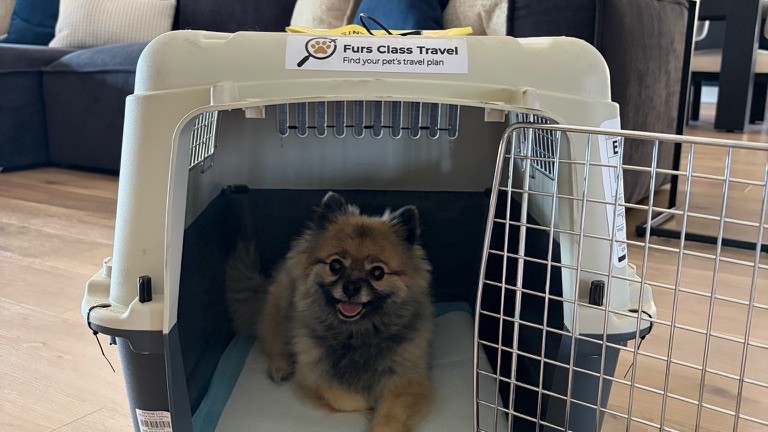
Fit is not the same as compliance
A dog fitting inside a crate proves very little. The real test is what happens when they stand, turn, and rest.
Length is measured from the tip of the nose to the base of the tail while standing. Height is measured from the floor to the top of the head, or the ear tips if they stand upright.
Even with those two measurements, body shape can change the answer. A crate that looks snug is often too small once the full IATA fit principle is applied. The free travel planner will tell you exactly what applies to your dog.
Flight-day preparation
Inside the crate, less is safer than more. Use absorbent pee pads on the floor. A familiar blanket or worn shirt can sit at the back for comfort. A water bottle attaches outside the door. Food travels in a ziplock bag taped to the top. Zip ties add security to the metal latch.
Do not leave loose toys inside. Hard objects can become hazards mid-flight. So can bedding that shifts.
This is a short final check, not a packing project.
Buy early enough for the crate to become familiar
Buying the crate close to the flight creates two avoidable problems. Standard sizes can sell out at popular retailers in summer and around major holidays. Your dog also loses the chance to settle into the crate before travel.
Buy it as early as possible — ideally months out, not weeks. A simple acclimatisation routine can make a meaningful difference. Keep the assembled crate open in a familiar part of the home. Meals and a familiar scent can help your dog choose to enter it. Once they do so voluntarily, short closed-door periods can begin at 30 seconds and build to several hours. Never use the crate as punishment.
Crate-trained pets typically settle within an hour of departure and rest for most of the flight. Pets that have not spent time in a crate are more likely to remain anxious. They may vocalise in transit or refuse food and water.
When a standard crate will not work
Major pet retailers in Dubai and Abu Dhabi widely stock PP30 through PP80. For most dogs, a standard off-the-shelf crate from a reputable retailer is sufficient once it passes the construction and fit checks above.
PP80, or Giant, is the largest standard size. A pet exceeding it needs a custom-built crate. This is not unusual for large breeds such as Mastiffs, Great Danes, and Saint Bernards. Custom builds take 2 to 4 weeks to manufacture, so allow extra lead time.
A specialist crate manufacturer or a vetted pet relocation company can arrange one. The free relocation planner will tell you whether a standard crate applies to your dog and match you with support on supported routes if it does not.
Frequently asked questions
Does "airline-approved" mean the crate will be accepted?
Can a soft-sided carrier travel as excess baggage or cargo?
Why do off-the-shelf crates so often fail?
What size does my dog need?
Where can I buy an IATA-compliant pet crate in the UAE?
How early should I buy my pet's travel crate?
End the guesswork before you buy
The rules are fixed. Your dog is not.
Use the free travel planner and I will tell you the correct IATA bucket. You will also know the airline-specific requirements for your route and whether your dog needs a custom crate.