
Last reviewed
Travel day is the day everything either falls into place or falls apart. By this point your dog has already cleared the hard parts — vaccinations, certificates, paperwork — but the airport is where unprepared owners get caught out. A missing document, a non-compliant crate, or a fed-too-recently dog can mean a refused boarding and a rebooked flight.
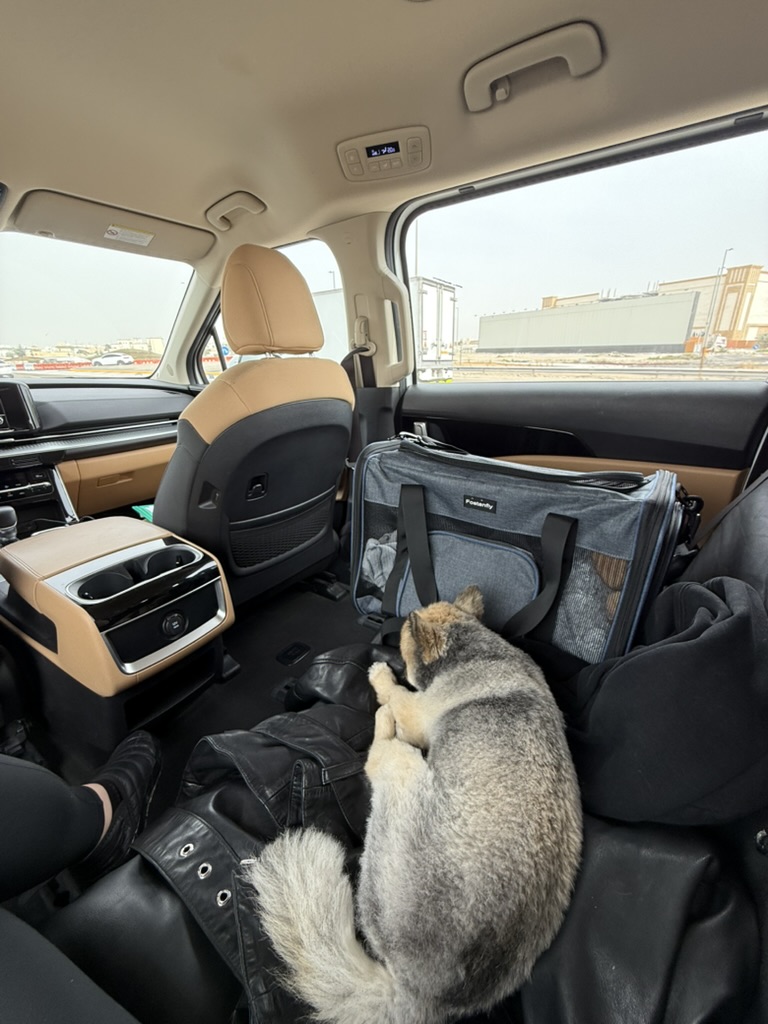
Kio has done travel day twice, in-cabin and as cargo.
This checklist covers everything you need for the day itself on a UK to UAE route — what to bring, how to prep the crate or carrier, what to do in the hours before departure, and what to expect when you land.
UK to UAE dog travel planner · Free · No signup
Quick summary
- •Bring originals plus copies of every document—print at home, in colour, and store in a clear plastic folder.
- •Crate or carrier IATA-compliant and prepped the night before—water bottle, food bag, absorbent pads, and "Live Animal" stickers all in place.
- •Follow your vet's and airline's feeding advice—many recommend a light meal several hours before, with water until check-in, and a bathroom break before leaving home.
- •Arrive at the airport at least 3 hours before departure for in-cabin travel—for cargo, follow your pet relocation company's drop-off time.
- •Your dog is normally released the same day—if everything matches.
Step 1. Document checklist
The free dog travel planner shows your dog's full checklist in order. This covers what a UK to UAE move typically needs.
Dog identification & health
Microchip certificate (ISO 15-digit)
Must be implanted before any vaccinations to be valid.
Rabies vaccination certificate
Given at least 21 days before travel, current and valid on the date of travel, with product, batch number and date given recorded.
Core vaccination record
Distemper, parvovirus, hepatitis and leptospirosis, as listed on EHC 3926.
Parasite treatment record
Internal and external treatment within 14 days of travel, recorded on the health certificate.
Fitness-to-fly certificate
Issued by your vet within 10 days of the flight; most airlines require this.
Export & import documents
Export health certificate (EHC 3926)
Signed by an Official Veterinarian. The Official Veterinarian examines your dog within 24 hours of export, and the certificate is valid for 10 days, so this needs to land close to your flight date.
MOCCAE Import Permit
Filed online before travel through the MOCCAE portal; valid 90 days from issuance (some older guidance says 30 days, but 90 is current).
Rabies Titre Test (RNATT)
Not required for dogs travelling directly from the UK. The UK is treated as low-risk by MOCCAE, so this step doesn't apply to this route.
Travel & airline documents
Flight booking confirmation
Airline booking for in-cabin, or an air waybill if travelling as cargo.
Flying in-cabin into Abu Dhabi: a customs Bill of Entry
Arranged before you land.
Copy of your passport or Emirates ID
If applicable to your application.
Any extra documents requested by your airline or pet relocation company
Always confirm 48 hours before departure, as requirements can change.
Step 2. Crate preparation (cargo)
Most dogs travel from the UK to the UAE as cargo, booked through a pet relocation company. The crate must be IATA-compliant and prepped to airline standards:
- IATA-compliant hard-shell crate labelled with "Live Animal" stickers on at least 4 sides
- Spring-loaded metal door — no plastic latches
- Metal nuts and bolts only — no plastic fasteners
- Water bottle attached to the outside of the crate door
- Food in a labelled ziplock bag taped to the top of the crate
- Absorbent pee pads on the crate floor
- Familiar blanket or worn shirt at the back for scent comfort
- Secure the crate door with cable ties, and leave wire cutters with the airline if requested
- No loose toys, treats, or hard chews inside the crate
Brachycephalic breeds need a crate one IATA size larger than standard, and are only accepted by Emirates and Etihad within their seasonal windows — see the brachycephalic breeds guide.
Step 3. Carrier preparation (in-cabin)
In-cabin is only available on Etihad, to Abu Dhabi, if your dog and carrier together weigh 8 kg or less, and some breeds aren't accepted. You book this directly with the airline, not through a pet relocation company. Excess baggage isn't available for dogs flying from the UK to the UAE.
- Airline-approved soft-sided carrier sized to fit under the seat in front of you
- Absorbent pad on the carrier floor
- Small amount of food and a few treats for the journey
- No loose toys inside the carrier
- Familiar blanket or worn shirt for comfort
Step 4. Before departure
- Follow your vet's and airline's feeding advice — many recommend a light meal several hours before, with water until check-in
- Bathroom break before arriving at the airport
- For in-cabin: arrive at least 3 hours before departure and go to the regular passenger check-in counter with your dog in the carrier
- For cargo: your pet relocation company handles check-in at the cargo terminal — follow their drop-off time and confirm handoff timing in advance
- Bring a leash and collar — required for handling at the airport
- Keep all original documents in a clear plastic folder, with copies for the crate and your carry-on
Step 5. On arrival
MOCCAE inspects the documents and your dog at the cargo village (or at Abu Dhabi airport for Etihad in-cabin arrivals). Your dog is normally released the same day if everything matches.
Common mistakes
"I'll print the documents at the airport."
Reality: Airport printers are unreliable, and airline counters may refuse digital-only health certificates. Print every document at home, in colour, and bring 1 original and 2 photocopies of each — one for the airline, one taped to the crate, and one for yourself.
"The vet certificate is dated last week — that's recent enough."
Reality: The Official Veterinarian examines your dog within 24 hours of export, and the EHC 3926 certificate is valid for 10 days. Check the dates line up with your actual departure before you book the vet visit.
"My dog can have breakfast — it's a long flight."
Reality: Follow your vet's and airline's feeding advice. Many recommend a light meal several hours before, with water until check-in.
"The crate door doesn't need securing."
Reality: For cargo travel, many airlines ask for the crate door to be secured with cable ties, with wire cutters left attached or available to ground crew.
"I'll sedate my dog so they're calmer."
Reality: IATA advises against sedating pets for air travel, and most airlines follow that guidance. Sedated dogs cannot regulate their body temperature or balance in pressurised holds, which is dangerous. If your dog is anxious, talk to your vet about non-sedative calming aids and crate training instead.
Frequently asked questions
How early should I prepare the documents?
Do I need to bring originals or are copies enough?
What if my flight is delayed?
Can my dog fly excess baggage from the UK?
Should I tranquillise my dog for the flight?
What happens at MOCCAE inspection on arrival?
Get my dog's travel plan
The checklist above covers what a UK to UAE move needs. The free dog travel planner shows how your dog can fly, what they need and when, and who I'd trust to help.