
Moving your dog from the UK to the UAE isn’t difficult because of any single rule. The challenge is getting every step in the right order—because one mistake can undo everything you’ve already done.
A rabies vaccination depends on the microchip. The import permit depends on the vaccination record. The export health certificate has its own short validity window. Then the crate, airline and cargo arrangements have to line up with all of it.
The good news is that the UK is classified by the UAE as a rabies-controlled, low-risk country. That removes one of the biggest hurdles in international pet travel: a rabies titre test is not required for dogs travelling directly from the UK. The challenge is getting the sequence, timing and logistics right.
In practice, most UK → UAE dog relocations take 6 to 10 weeks if the microchip and rabies vaccination are already in order. A realistic full-service budget is around £1,895–£4,000+ per dog, with a UAE arrival add-on of roughly £500–£700 typically quoted separately.
UK → UAE dog relocation · Free · No signup
Quick summary
- •6 to 10 weeks end to end—assuming the microchip and rabies vaccination are already in order.
- •No rabies titre test required—the UAE classifies the UK as a low-risk rabies country.
- •Dogs fly as cargo—not in the cabin. The only in-cabin exception is Etihad to Abu Dhabi, with strict limits.
- •MOCCAE import permit valid for 90 days—confirmed directly by MOCCAE; some older sources still quote 30 days — 90 is current.
- •Realistic 2026 budget: ~£1,895–£4,000+ per dog—plus a UAE arrival add-on of ~£500–£700 (import permit, customs, delivery); larger and snub-nosed breeds sit at the upper end.
The rules that matter most
On paper, UK → UAE is one of the more favourable corridors. There is no titre test, and no mandatory quarantine on arrival when everything is compliant. What makes it feel overwhelming is the chain of dependencies:
- Microchip before rabies vaccination
- Rabies vaccination followed by a 21-day wait
- MOCCAE import permit valid for 90 days from issuance
- UK export health certification shortly before departure
- Cargo for most UK departures, with limited airline-specific exceptions
- Correct crate, routing and temperature arrangements
Get those pieces aligned and the journey becomes much more predictable. Out of order, the whole timeline can reset.
Step 1. First, make sure your dog is allowed to enter
Before booking a flight, buying a crate or arranging vaccinations, check the breed rules. The UAE restricts a number of dog breeds and their crosses. The UK export health certificate (EHC 3926) lists the following prohibited breeds:
- Pit Bull Terrier, American Pit Bull Terrier
- Staffordshire Bull Terrier, American Staffordshire Terrier, American Bully
- Japanese Tosa, Dogo Argentino, Fila Brasileiro
- Tibetan Mastiff, Neapolitan Mastiff, French Mastiff (Dogue de Bordeaux), Bullmastiff
- Boerboel, Cane Corso, Presa Canario, Bully Kutta
This catches UK owners out because Staffordshire Bull Terriers and Bullmastiffs are relatively common. Breed assessment can also be based on physical characteristics rather than pedigree, which means a mixed-breed dog that resembles one of the restricted types can still face problems at the border.
Where there is uncertainty, owners may obtain veterinary or DNA documentation in advance. Limited exemptions exist for certified service or support animals where the required formal documentation is in place. If breed eligibility is unclear, resolve it before starting the rest of the process.
Step 2. Your dog's microchip is the identity behind the whole file
The microchip is the starting point for everything that follows. Your dog needs a 15-digit ISO-compliant microchip, and it must be implanted before the rabies vaccination used for the journey. The chip number then needs to match the vaccination records and export paperwork exactly.
If the rabies vaccination was given before the microchip was implanted, the vaccination may be treated as invalid for export. This is one of those details that looks minor until it creates a problem — a healthy dog with otherwise correct paperwork can still be delayed if the identification trail does not match.
If your dog has an older non-ISO microchip, upgrading it is usually recommended to avoid scanning problems at the UAE border.
Step 3. Rabies timing is the first major deadline
Once the microchip is in place, the rabies vaccination can be given. For a UK → UAE journey:
- The rabies vaccination must be given after, or on the same day as, the microchip
- There must be at least 21 days between vaccination and travel
- The vaccination must still be valid when the dog enters the UAE
A rabies antibody titre test (RNATT) is not required for dogs travelling directly from the UK, because the UK is treated as a low-risk rabies country. That 21-day period is important: it is not an administrative wait that can be shortened because the rest of the paperwork is ready.
Core vaccinations
Your dog also needs current core vaccinations covering:
- Canine distemper virus
- Canine parvovirus
- Canine adenovirus / infectious hepatitis
- Leptospirosis
These need to be properly recorded, including relevant dates, batch details and veterinary stamps. The rabies requirement and the wider vaccination record together form the foundation for the UAE import permit and the export paperwork.
Step 4. The MOCCAE permit comes once the vaccination record is ready
Before your dog enters the UAE, an official import permit is required from the UAE Ministry of Climate Change and Environment (MOCCAE). It is one of the most time-sensitive documents in the process.
- The application uses the dog's vaccination and microchip information
- A pet relocation company can submit it online on your behalf
- The government fee is typically around AED 200 per dog
- Valid for 90 days from issuance — your dog must physically enter the UAE before it expires
Important clarification
You may still find older information stating that the permit is valid for 30 days. Some third-party sources continue to repeat it, and older wording has appeared on MOCCAE's public-facing service information. MOCCAE has confirmed directly by email that the current validity is 90 days from issuance. That is the authoritative figure to plan against.
That does not mean the permit should be obtained as early as possible. The application still needs to fit the vaccination record and your actual travel date. For the detailed regulatory requirements and the 90-day validity clarification, see our MOCCAE import rules for UK owners.
Step 5. The final UK paperwork is where timing becomes tight
The UK side of the journey is handled through the Animal and Plant Health Agency (APHA), under DEFRA rules, using the official export health certificate for the UAE. Your dog needs an Export Health Certificate (EHC 3926) issued by an APHA-authorised Official Veterinarian.
The certificate is prepared shortly before departure, typically around the day before the flight. Your Official Veterinarian or pet relocation company should confirm the exact appointment timing for your journey.
Parasite treatment
The EHC requires external and internal parasite treatment before export. External treatment uses an appropriate product such as Fipronil or Permethrin, while internal treatment must contain Praziquantel. These treatments must be given less than 14 days before travel, in accordance with the requirements recorded on EHC 3926.
Fitness to fly
Your UK vet must also issue a Fitness-to-Fly Certificate within 10 days of the flight. Most airlines require this vet-signed certificate in addition to the export health certificate, confirming that your dog is healthy enough for cargo travel. In practice, the assessment is often carried out at the same appointment as the final export paperwork.
This is why the final veterinary appointment needs to be planned around the flight rather than treated as a routine vaccination visit.
Step 6. The crate is part of the transport approval
Once the paperwork is in place, the physical transport becomes the next constraint. For dogs travelling as cargo, the crate is not simply luggage — it is part of the airline's acceptance requirements. The crate should be:
- IATA-compliant and hard-sided
- Secured with metal fasteners rather than plastic clips
- Ventilated on multiple sides
- Large enough for the dog to stand, turn around and lie down comfortably
Crate dimensions also affect the price. Cargo is generally priced using the shipment's volumetric dimensions, so a larger crate can increase the freight charge significantly even when the dog itself is relatively light. For sizing and construction requirements, see our IATA dog crate requirements.
Step 7. Then comes the flight — and this is not normal passenger travel
One of the biggest surprises for UK owners is that their dog generally cannot simply be added to the passenger booking. For most UK departures to the UAE, dogs travel as cargo, using a dedicated Air Waybill, a temperature-controlled hold and separate cargo handling rather than passenger baggage.
Major operators serving this market include Emirates, Etihad and British Airways' cargo divisions, subject to route and animal acceptance requirements. There is a limited in-cabin exception with Etihad to Abu Dhabi, but strict weight and age conditions apply. Do not assume that an airline's general international pet policy applies to a UK departure.
There is one further option beyond cargo: a small number of operators run pet-dedicated private jet services, where your dog stays with you in the cabin rather than travelling as cargo. This isn't available on every route or for every dog, and it comes at a significantly higher cost than cargo — but for owners who want to avoid cargo entirely, it's worth knowing the option exists before assuming cargo is the only route in or out of the UAE. Our free travel planner will show you if it's available for your dog's breed, size, and travel date.
Heat can change the flight plan
UAE routes also have a significant temperature constraint. During hotter periods, airlines can impose restrictions when ground temperatures exceed their safe operating limits. Brachycephalic, or snub-nosed, breeds can face additional restrictions and in some cases seasonal bans. That means the safest flight is not necessarily the cheapest or the most convenient one. See our brachycephalic breeds and air travel guide if your dog is a snub-nosed breed.
Step 8. Arrival in the UAE: cargo facility, inspection, then release
Your dog does not arrive through normal passenger baggage. At Dubai or Abu Dhabi, the shipment is transferred to a dedicated animal cargo facility. Officials check the microchip, vaccination records and import permit, and carry out a basic veterinary inspection. If the microchip and documents match the requirements, a compliant UK import is normally released the same day, without quarantine.
There is no standard quarantine for a compliant UK import
A dog arriving from the UK with the correct documentation does not automatically enter quarantine. Problems arise when the paperwork is missing, expired or inconsistent. In those circumstances, authorities can impose quarantine or refuse entry.
This is why the small details earlier in the process matter. A mismatch in a microchip number, or an incorrectly timed document, becomes an arrival problem rather than something a relocation company can simply correct afterwards.
Budget for arrival charges
The UAE side can include veterinary inspection fees, terminal handling, customs release and delivery. Veterinary inspection fees can be around AED 1,000 per dog, with additional terminal handling, customs and possible timing-related charges depending on the arrival arrangements. These costs are commonly included in, or quoted alongside, a UAE arrival add-on of roughly £500–£700.
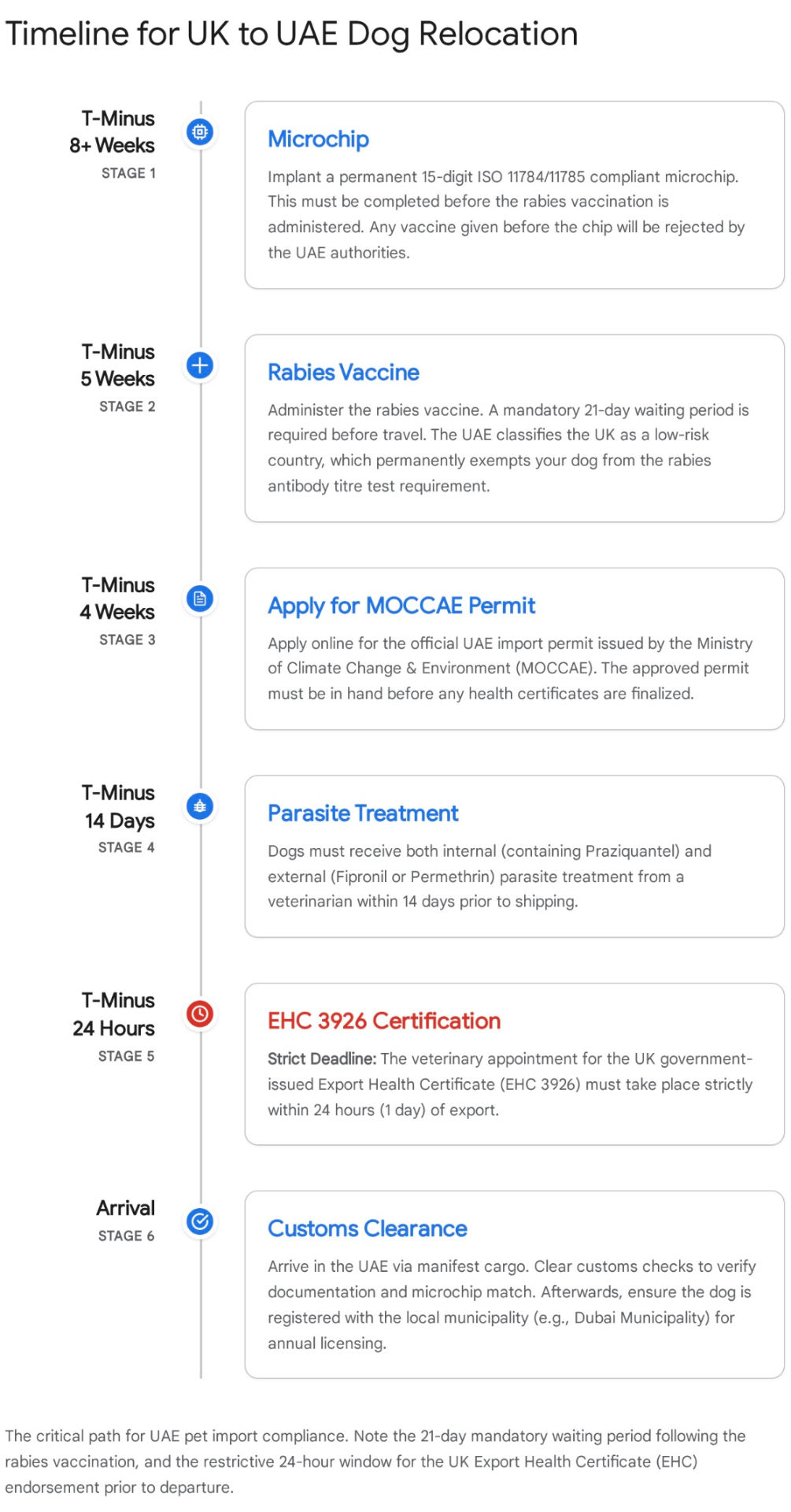
Step 9. The timeline: what the whole process looks like
For a dog starting with a compliant microchip and current rabies vaccination, the process commonly fits into a 6–10 week window.
Weeks 1–2 — establish the paperwork
Confirm breed eligibility, microchip your dog if that has not been done, and check the vaccination records so anything that needs correcting is identified early.
Weeks 2–4 — rabies and the 21-day clock
If a new rabies vaccination is required, give it after the microchip and begin the mandatory 21-day waiting period.
Weeks 4–6 — import approval and flight planning
Apply for the MOCCAE import permit once the vaccination records are ready, and begin confirming the cargo flight and crate arrangements.
Weeks 5–7 — lock in transport
Confirm the airline, cargo booking, crate dimensions and any seasonal temperature restrictions.
Final 14 days — parasite treatment
Complete the required internal and external parasite treatments less than 14 days before travel.
Final 10 days — fitness to fly
Arrange the Fitness-to-Fly Certificate within 10 days of the flight, often at the same appointment as the export paperwork.
Shortly before departure — EHC 3926
The APHA-authorised Official Veterinarian completes the export health certification shortly before departure, typically around the day before travel. Confirm the exact timing with your OV or pet relocation company.
Departure and arrival
Your dog travels as cargo, enters the UAE through the designated animal cargo facility, and is released after document and veterinary checks if everything matches.
For a wider look at how pet relocation timelines are built, see our pet travel timeline guide.
Step 10. What does it cost to move a dog from the UK to the UAE?
There is no single price, because crate dimensions, dog size, airline, route and level of relocation support all affect the final cost. Typical costs include:
- UK veterinary care and vaccinations
- Export health certificate and veterinary inspections
- Travel crate
- Cargo freight
- UAE import permit
- UAE veterinary inspection
- Terminal handling and customs
- Delivery
- Optional relocation support
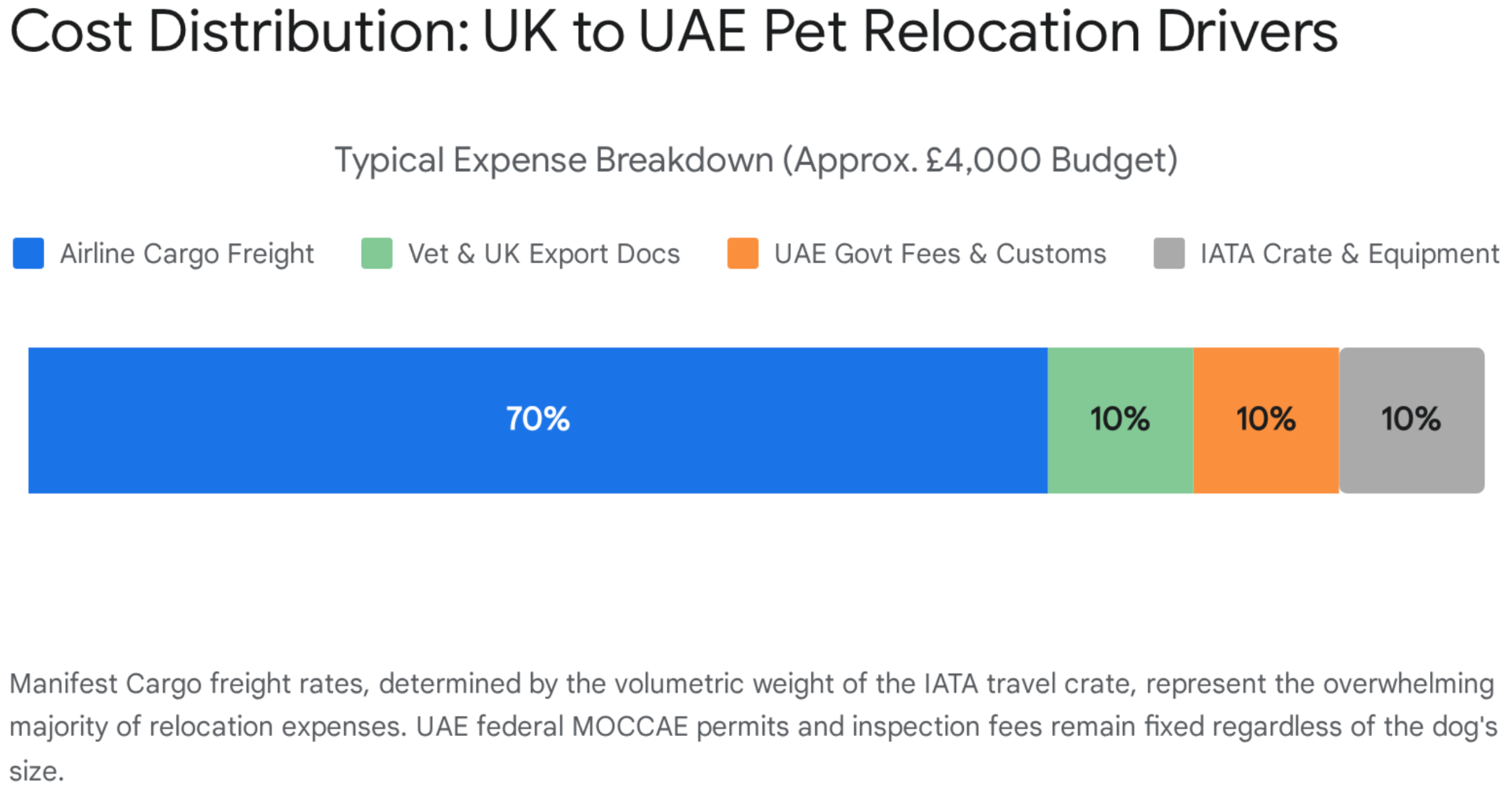
A realistic 2026 full-service range is approximately £1,895–£4,000+ per dog. A UAE arrival add-on of roughly £500–£700 is commonly quoted separately for items such as the import permit, customs clearance and delivery.
Larger dogs and snub-nosed breeds generally sit towards the upper end because of crate dimensions, freight requirements and airline restrictions. Cargo freight is usually the biggest variable, because the charge is driven heavily by crate volume rather than simply the dog's body weight. For the detailed numbers, see our cost to move a dog from the UK to the UAE guide.
Arrival is not the end of the process
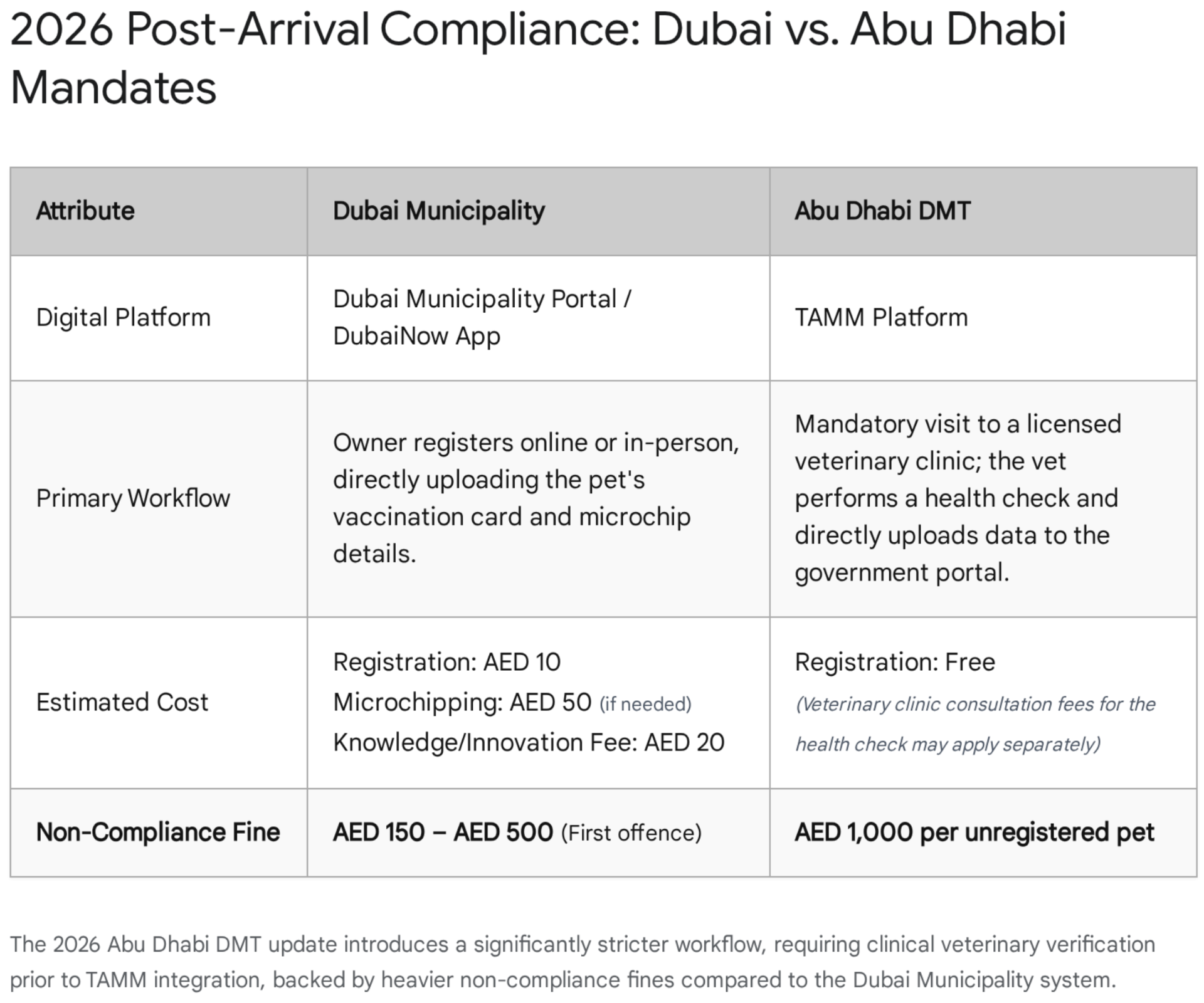
Clearing customs gets your dog into the UAE, but there can still be local registration requirements afterwards. Dubai and Abu Dhabi follow the same federal MOCCAE import rules, but their post-arrival registration systems, municipality apps, fees and fines differ.
If you are choosing between the two emirates, check the local requirements separately rather than assuming that federal import clearance completes every obligation.
The five things that cannot go wrong
The entire journey can be reduced to five critical points:
- Microchip first
- Rabies vaccination, followed by the 21-day wait
- MOCCAE import permit, valid for 90 days from issuance
- Correct UK export health certification shortly before departure
- Correct cargo, crate and airline arrangements
The process itself is manageable. The difficulty is that these steps depend on one another — get one out of sequence and the delay can affect everything that follows.
Frequently asked questions
How long does it take to move a dog from the UK to the UAE?
Does the UAE require a rabies titre test for dogs from the UK?
Can my dog fly in the cabin from the UK to the UAE?
How long is the MOCCAE import permit valid?
What happens if the paperwork is wrong?
What does it cost to move a dog from the UK to the UAE?
Get your dog's exact travel plan
A general guide can tell you the rules. It cannot tell you exactly how those rules apply to your dog's vaccination history, breed, travel month, crate size and airline. That's where the planning matters.
Use our free travel planner on the homepage for your dog's travel plan — your sequence, the steps that apply to your specific situation, and the documentation timeline.
For the regulatory deep-dive, see our MOCCAE import rules explainer. For the line-by-line budget, see our cost guide.